Iris Murdoch's The Sea, the Sea, published in 1978, opens with twenty pages that do, when one attends to them carefully, something formally remarkable. The novel is narrated in the first person by Charles Arrowby, a retired theatre director who has bought a house on a remote section of the English coast and who has begun, on the day the novel opens, the writing of a memoir-cum-journal. The opening sets up the formal apparatus through which the entire novel will be filtered — Arrowby's consciousness, his prose, his selections and suppressions — and the establishment of the apparatus is more carefully managed than the surface chattiness of the prose tends to suggest.
The aim of this piece is to read those twenty pages slowly, attending to what Murdoch is doing at the level of sentence and structure, and to try to make explicit what most readings of the novel leave implicit. The novel rewards close attention; the opening rewards it particularly, because the formal moves Murdoch is making in those pages will determine what is and is not available to her over the subsequent five hundred.
The first sentence and what it accomplishes
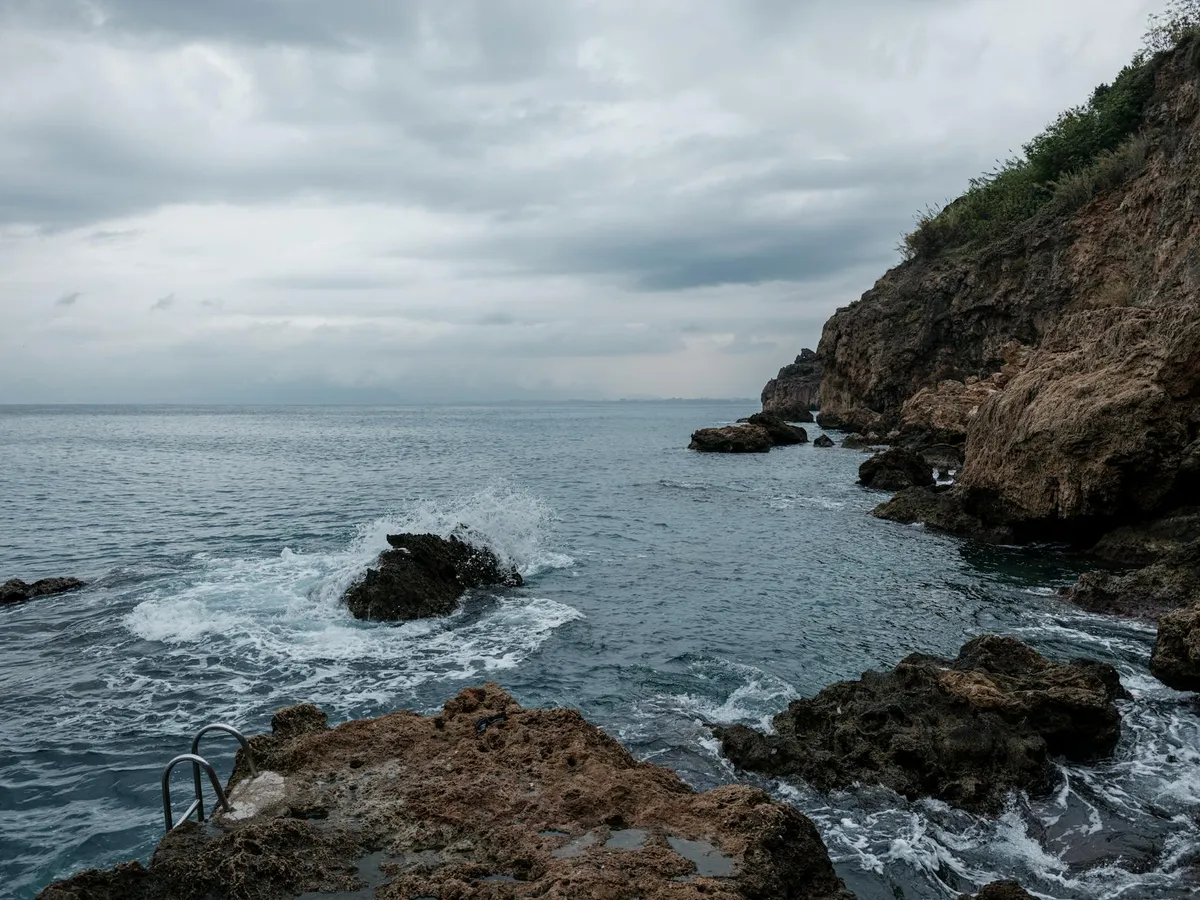
The novel opens: The sea which lies before me as I write glows rather than sparkles in the bland May sunshine. The sentence appears artless but is in fact doing several things at once. It places the narrator immediately in the relation to the sea that the title has already announced; it locates us in the act of writing, with the present tense (lies before me as I write) establishing the writing-in-progress as the formal frame of the narration; and it offers, in the choice between glows and sparkles, the first instance of what will become the novel's characteristic mode — Arrowby exercising aesthetic judgement on a small perceptual detail, with the judgement carrying more weight than the observed detail can quite support.
The word bland in bland May sunshine is doing particularly hard work. May sunshine in coastal England in the late 1970s would be, on the standard descriptive vocabulary, mild or pale or watery. Bland implies an evaluative disposition that the situation does not quite require, and the implication is the reader's first piece of evidence about the kind of consciousness through which this entire novel will be filtered. Arrowby is the man who finds May sunshine bland. Note that Murdoch does not have to comment on this; the word does the work.
The second sentence, which I will not quote at length, extends the perceptual register but also extends the slight edge of self-importance that the first sentence has already begun to introduce. By the end of the first paragraph, we know we are reading a narrator whose relationship to his own observations is more deliberate than the conventional first-person memoirist would deploy, and whose tonal register is one in which aesthetic judgement is being made constantly, with a kind of casual authority that the prose itself does not quite earn.
The second page and the arrival of the past
The second page begins to introduce the past. Arrowby has retired from the theatre; he has come to this house; he is going to write his memoirs. The introduction of biographical material is handled, importantly, with apparent casualness. Arrowby drops names — Sidney Aspern, Wilfred Dunning, the various theatrical figures of his career — without explaining them, in a way that establishes him as a man who assumes the reader is familiar with the milieu he comes from. The assumption is itself a piece of characterisation. The narrator who assumes the reader's familiarity with his world is a narrator who has not entirely understood how peripheral his world is from the perspective of a general readership.
This is one of the moves that Murdoch is consistently making in the opening. The narration appears to be unselfconscious, but the narrator's self-presentation is being undermined by the very details he chooses to include. The reader is positioned, from the first paragraph, in a stance of slight ironic distance from Arrowby — not so much that the narration becomes unreliable in the technical sense, but enough that we know to read what Arrowby says with attention to what he is and is not noticing about himself.
The introduction of the past also establishes the temporal layering that the novel will work with. We are reading Arrowby writing now, in the May of the present, but he is going to write about a career that is already over and a life that is already largely behind him. The present-tense framing of the writing combined with the past-tense narrative content produces a structural tension that the entire novel will deploy. Murdoch sets this up in the first three pages and does not have to explain it; the apparatus is in place by the time the actual narrative material begins to arrive.
The middle pages and the introduction of the house
Pages four through ten are largely devoted to the description of the house Arrowby has bought and of the surrounding landscape. The description is detailed in a particular way: Arrowby attends to physical details of the house — the rooms, the staircase, the kitchen, the small upstairs study — with the kind of careful registration that one would expect from a man whose previous profession was the theatrical and the visual. The descriptions are, on their surface, unremarkable; they are the kind of descriptions that any first-person narrator might produce when establishing the setting.
What is doing the actual work in these pages is the slightly excessive specificity of certain details, which carry a charge that the narrator does not seem fully to recognise. The mirror in the front hall is described at length; the small inner room with no obvious purpose is described with the kind of dwelling that the reader's eye may register as significant; the staircase is presented with attention to its peculiarities. Murdoch is salting the description with elements that will, over the course of the long novel, accumulate symbolic and narrative weight. The salting is done discreetly, but it is done.
The reader who is reading slowly will begin to register, by the eighth or ninth page, that Arrowby is a narrator who is selecting carefully without quite knowing what his selections are doing. This is a quite specific and rather rare effect to produce in first-person narration. The narrator who selects without knowing he is selecting is the narrator whose self-presentation will, over the course of a long novel, prove to be more constructed and less reliable than the surface-tone of the prose suggests. Murdoch is establishing this in the description of the house, and she is doing it without any obvious signalling.
The dietary register and what it tells us
One of the features of these opening pages that has attracted the most discussion in the existing criticism is Arrowby's extensive attention to food. He describes, in some detail, the simple meals he is preparing for himself — the careful arrangements of olives and biscuits, the boiled eggs, the wine. The food descriptions have generally been read as comic, and they are comic, but they are comic in a particular way that does work for the larger characterisation.
The food descriptions show Arrowby in the act of self-presentation. The man who has retired to a remote coastal house is presenting himself to himself, on the page he is writing, as a man of careful aesthetic relation to his own simple life. The descriptions are not actually descriptions of meals; they are performances of the kind of life Arrowby wishes to be seen as living. The reader who registers this — and the registration becomes, with repeated reading, almost involuntary — has a different relationship to Arrowby than the reader who takes the food descriptions at face value.
The Murdoch-comedy in these pages is a specific kind of comedy. It does not depend on the narrator being foolish in any direct sense; Arrowby is intelligent, articulate, and capable of considerable observation. The comedy depends on the gap between his self-presentation and what the prose itself is allowing the reader to see. The comedy is structural, and it is being established in the opening as the dominant mode through which the novel will operate.
The arrival of the strange experience
Around page eighteen of the opening section, the first of the novel's strange experiences arrives. Arrowby sees, in the sea, what he thinks may be a sea-monster. The sighting is described with the same tone of careful registration that the rest of the section has employed — the prose does not break register; the experience is treated by the narrator as something to be described accurately, rather than as something to be excited or fearful about.
The handling of this moment is, I think, one of the most accomplished things in the opening. Murdoch could have used the sighting to crank up the prose register, to introduce the supernatural element with rhetorical fanfare, to mark the shift from the domestic establishment to the more uncanny material the novel will eventually develop. She does none of this. The sighting is integrated into the existing tonal register, and the reader is left to do the work of registering its strangeness against the equanimity of the narration.
This is consistent with Murdoch's general method in the novel. The supernatural and the uncanny will arrive in the prose without rhetorical announcement, and the reader will be required to do the work of registering them as supernatural against a narration that does not visibly register them as such. The opening establishes the method, and the establishment is part of why the long novel that follows is able to do what it does.
What the opening accomplishes
By page twenty, Murdoch has established: the spatial setting; the temporal framing of the narration; the dominant tone, which is comic-ironic in a specific and unobvious sense; the narrator's self-presentation, which the reader is being shown how to read against; and the formal apparatus through which the novel will register the supernatural and the uncanny when they arrive. The accomplishment, in twenty pages, is substantial. The novel has not yet introduced the central plot, the lost-love that will drive the action, the various ex-colleagues and ex-lovers who will arrive at the house. None of this material has yet appeared. What has appeared is the formal apparatus through which all of this material will be presented and through which the reader will be required to read it.
The opening is, in this sense, a piece of structural establishment that the novel could not have done without. The work is not visible in the way that openings of more declaratively ambitious novels make their work visible. The work is done quietly, through tonal precision and through the carefully managed selection of details. The reader who reads the opening at speed will not notice most of what Murdoch is doing. The reader who reads slowly will notice, and the notice will determine how the rest of the novel reads.
This is what close reading is good for, in the contemporary critical economy where it has largely been abandoned. The novels that reward close reading reveal, when read closely, things that the standard reception cannot show. Murdoch's opening is one of the more obvious examples in postwar British fiction, but it is not unique; the opening of The Black Prince does similar work in a different register, as does the opening of Nuns and Soldiers, as do — in radically different idioms — the openings of late-period Spark, of Anita Brookner, of Elizabeth Taylor. The common feature is the discreet establishment of a formal apparatus that the rest of the novel will deploy. The criticism that does not read closely cannot describe this work; the criticism that does read closely has to. The exercise is worth more time than the contemporary review economy can give it. The novels reward the time when it is given.